.png)
Every Drop Counts: Singapore’s Water Security Strategy (Part 2)

In this Explainer, find out...
How does Singapore manage its water demand?
What is the impact of Singapore’s water demand management measures?
How does Singapore’s water model compare to that of other water-scarce countries?
Introduction
In the previous half of this Policy Explainer, we examined the rationale, means and reliability of Singapore’s “Four National Taps” supply strategy in ensuring Singapore’s water security. In this second part, we move on to the demand-side of its water policy, evaluating its impact on households and businesses. Finally, we compare the design of Singapore’s water model to that of other countries.
Water Demand Management Measures
Beyond expanding its water supply, Singapore tries to moderate its water demand to uphold its water security. This is to prevent demand from outstripping supply, which would result in a water shortage. To this end, the Government has enacted a range of water demand management policies.
(i) Water Pricing
First, the Government prices water in a way to discourage wastage. Generally, the water price includes three components:
Water Tariff: to cover the cost of producing potable water, charged based on amount used;
Water Conservation Tax: to encourage water consumption, charged as a percentage of the Water Tariff; and
Waterborne Tax: to cover the cost of treating used water, charged based on amount used.
(ii) Water Efficiency Labelling Scheme
Second, the Government has introduced the Water Efficiency Labelling Scheme (WELS) for products like taps, washing machines and flushing systems. Launched in 2009, WELS is a grading system that rates the water efficiency of appliances on a scale of zero to four ticks. The more ticks an appliance has, the more water-efficient it is.
It is mandatory for most water-using appliances to prominently display their WELS labels (see Figure 1). This helps consumers make informed choices when purchasing such products, which could promote water conservation among households.
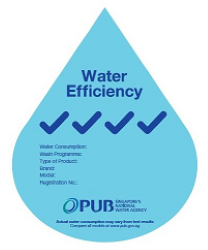
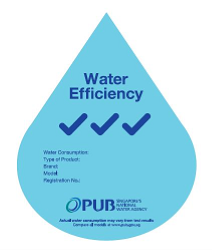
Figure 1: Mandatory WELS Labels
(iii) Water Efficiency Management Practices and Requirements
A third initiative has been the implementation of mandatory water efficiency management practices and requirements for businesses that use a large volume of water. PUB requires users who consume 60,000 m3 or more of water in a year (the average household uses about 50 m3 annually) to complete three tasks. First, they have to submit details of their water consumption patterns. Second, they have to appoint at least one water efficiency manager. Third, they have to submit water efficiency plans to PUB yearly to demonstrate a commitment to reduce water use.
To advance water sustainability in the non-domestic sector, PUB introduced additional requirements in 2024 for selected new projects consuming at least 60,000 m3 of water annually. These requirements were targeted at particularly water-intensive industries:
Semiconductor plants: must have a minimum water recycling rate of 50 per cent; and
Electronics, biomedical and pharmaceutical plants: must recycle specified waste streams.
(iv) Public Campaigns and Education
Finally, PUB runs annual public campaigns to encourage households and businesses to manage their water demand. The agency has also partnered with schools to organise learning journeys and modules for students to better appreciate water conservation.
What Is The Impact Of Water Demand Management Measures?
Singapore’s efforts to manage water demand are comprehensive in that they engage both households and industries. Infrastructural policies like the implementation of water efficiency management requirements target large industrial water users. At the same time, the WELS initiative and PUB awareness campaigns operate at the psychological level, nudging households towards water conservation. Overall, these policies neatly complement supply-side measures, reducing the risk of water demand outpacing supply.
In practice, however, these policies may be limited in their impact. Local household water consumption has declined from 165 litres a day in 2000 to 141 litres a day in 2018. However, this figure appears to have stagnated more recently (excluding the immediate post-pandemic period). In the past decade, the lowest water consumption per person has remained at 141 litres per day, recorded in 2025, 2023, 2019 and 2018. While still comparable to residential water use in regions like Europe (144 litres per person per day), this trend suggests that PUB’s water demand management policies may be yielding diminishing returns.
Furthermore, there are trade-offs to leveraging water pricing to manage demand. On the one hand, higher water prices may lower the amount of water used and even fund larger investments in water infrastructure. On the other hand, however, such price hikes (e.g., of 18 per cent in 2024–2025) raise the cost of living. They also disproportionately affect lower-income households, who usually spend a larger portion of their income on necessities like water. Such impacts have been mitigated to a degree through subsidies issued by the Government. That said, such interventions show that maintaining the balance of water supply and demand can come with its fair share of trade-offs. In this sense, water pricing reflects a broader tension in Singapore’s water policy: achieving water security often requires compromise in other policy areas.
Comparing With Other Water-Scarce Countries
Having outlined Singapore’s approach to water security, it is instructive to compare it with other models in similarly water-scarce countries like Israel and Australia. This can help us better understand the strengths, trade-offs and underlying principles of Singapore’s water policy.
Israel
Israel’s Water Situation
Israel is a physically water-scarce country due to its dry climate and limited natural freshwater sources. Climate change will probably exacerbate this problem, reducing rainfall and increasing variability in drought conditions. However, Israel consumes a lot of water for household and agricultural needs. The country will need more of it as its population grows — domestic water demand could rise by as much as 160 per cent by 2065.
Israel’s Approach
To provide its people with sufficient, clean water, Israel has invested heavily into water infrastructure and technology. The National Water Carrier of Israel, completed in 1964, is a canal that transports freshwater from the Sea of Galilee in the country’s north to its drier central and southern areas (see Figure 2).

Israel’s reliance on natural freshwater sources has since lessened, as it expands its wastewater reclamation and desalination capabilities. Today, almost 90 per cent of wastewater in Israel is treated and reused, mainly for agricultural irrigation. Meanwhile, desalination plants purify water from the Mediterranean Sea, as well as brackish water (a mixture of seawater and freshwater). Altogether, desalination supplies over 80 per cent of the nation’s urban water needs (i.e., water that is not used for agriculture).
To moderate water use, Israel targets households and farms, which collectively account for 87 per cent of total water consumption. Amidst consecutive droughts in the 2000s, its government launched various awareness campaigns urging the public to save water. Israel also pioneered drip irrigation, which is a way of delivering water directly to plant roots, reducing water loss via evaporation. Most of its farms use this water-saving technology.
As a result of these efforts, Israel has turned its physical water scarcity into water security. In fact, it currently produces more clean water than it needs, and exports this surplus to neighbouring countries like Jordan.
Comparing Approaches: Israel vs. Singapore
A comparison between Singapore and Israel’s water policies demonstrates how they converge in their technological approach to mitigating water scarcity. Both countries rely heavily on innovative methods like wastewater reclamation and desalination to secure their water supply. As a result of their successful water policies, both Singapore and Israel are internationally recognised as models for water management., In this sense, the two countries demonstrate how technology can be harnessed to overcome their natural limitations.
However, the comparison also underscores how a country’s geographical and economic contexts shape its policy design. Compared to Singapore, Israel is a much larger nation. To transport water from where it is sourced to where it is used, Israel had to invest in extensive infrastructural networks like its National Water Carrier. This is arguably less of a priority for Singapore, given its small geographical size.
Unlike Singapore, the agricultural sector contributes billions of dollars (in US$) to the Israeli economy and consumes plenty of water. Whereas Singapore prioritises its highly treated reclaimed wastewater for urban needs, Israel channels its treated wastewater to farms. The Middle Eastern country has also invested in advanced irrigation methods to moderate agricultural water demand. Hence, this comparison reveals how — even with similar tools — water policy ultimately reflects a nation’s geography and economic structure.
Australia
Australia’s Water Situation
Australia is another water-scarce country. As the driest inhabited continent, Australia receives limited and unpredictable rainfall. With climate change bringing rising temperatures, what little surface water remains is evaporating at higher rates. Yet Australia’s farms, industries and households continue to consume a large amount of water.
Australia’s Approach
To manage the twin challenges of strained water supply and growing demand, Australia has expanded its wastewater recycling and desalination capabilities. It has also invested in upgrading farm irrigation systems and labelling products for water efficiency.
Beyond conventional policies, Australia has developed water markets as an innovative way of allocating water. These markets allow users to buy and sell “water rights”, which include water entitlements and allocations. A water entitlement is an ongoing right to a share of the water available in a particular water system. In contrast, a water allocation is the specific amount of water that the entitlement holder is allowed to access in a particular year (see Figure 3). A water entitlement trade thus represents a permanent transfer of water access rights, whereas a water allocation trade involves the temporary transfer of water.

Water markets operate on a “cap and trade” system. Every year, the authorities set a cap, or limit, on the amount of water that can be extracted from each water catchment. This amount depends on overall water availability, and is reduced in times of drought. This allows the Australian government to moderate water consumption when supply is low.
Once the cap is set, the rights to use the water within that limit is distributed and traded among users through water entitlements and allocations. Most participants in Australian water markets are farmers, who need water for irrigation. Other participants include investors and urban water utilities, which provide clean water to households and businesses.
Over the past 30 years, Australia’s water markets have grown rapidly. Over A$4 billion worth of water was traded between users in 2021–2022. Indeed, these markets are recognised internationally as an example of successful water policy reform.
Comparing Approaches: Australia vs. Singapore
Comparing Singapore and Australia’s water policies demonstrates a difference in the degree of state control. Water pricing in Singapore is directly set by PUB, a government agency. Conversely, Australian water prices are driven by supply and demand forces in markets for water rights. The Australian government plays a comparatively limited role in establishing overall extraction limits and regulating trading rules.
The advantage of Australia’s market-based approach is that water can be re-allocated from lower-value to higher-value uses. The logic here is that water would flow to buyers who can make the most value with it, as they would be willing to pay the highest price for the water. To illustrate, consider two farmers: one who grows wheat and another who grows premium grapes. In a dry year, the wheat farmer can sell his water allocation to the grape farmer. This not only ensures that the high-value grapes survive, but also allows the wheat farmer to earn revenue from his water sale.
Regardless of the extent of state control, both Singapore and Australia’s approaches achieve the intended effect of having water prices signal the level of scarcity. They function as useful policy tools for managing and conserving each country’s water supply.
Conclusion
Overall, Singapore’s water model is an exercise in sustained and meticulous policymaking — evolving over decades while planning far into the future. It stands out from other approaches for its integration of technological innovation with centralised governance to manage water scarcity. By combining supply diversification with demand management, Singapore secures a resilient and sustainable water system where every drop really counts.
Singapore’s pursuit of water self-sufficiency is driven by the need to guard against supply shocks and safeguard national security. However, this goal entails trade-offs, not least a growing reliance on costly, energy-intensive solutions. For now, the city-state still depends on Malaysia for much of its water. Complete self-sufficiency therefore remains a distance away, as Singapore’s water story continues to unfold.
This Policy Explainer was written by members of MAJU. MAJU is a ground-up, fully youth-led organisation dedicated to empowering Singaporean youths in policy discourse and co-creation.
By promoting constructive dialogue and serving as a bridge between youths and the Government, we hope to drive the keMAJUan (progress!) of Singapore.


Comments